
News
Follow the latest developments surrounding INVITE 2.0 and find out more about upcoming events.
International Lecture Series: SDG 4.7 and Global Education
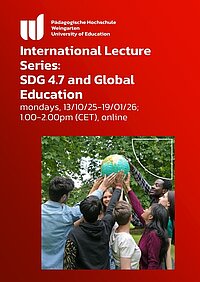
As part of our Baden-Württemberg network, INVITE 2.0 presents this lecture series on the topic of ‘SDG 4.7 and Global Education’.
From October 2025 to January 2026, experts from around the world invite you to discuss the importance of UN Sustainable Development Goal 4.7: inclusive, equitable and sustainable education for all.
Experience exciting insights, international examples of good practice and intercultural exchange – every Monday, online and connected worldwide.
You cannot get Credit points for this lecture series. More information can be found in the flyer.
Latest events
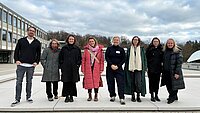
As part of INVITE 2.0, the international workshop "Teaching with AI tools: The Role of AI in Transforming Teacher Education" took place on 26th and 27th November 2025 at Ludwigsburg University of Education. The event was attended by faculty members from various disciplines at PHL, as well as representatives from partner universities in Norway (OsloMet), Denmark (University College Copenhagen), Romania (Babeș-Bolyai University), and Estonia (University of Tartu).
A key focus of the event was the keynote by Helen Hint (University of Tartu), who spoke about a university-wide working group that supports teachers in using AI in teaching and learning, as well as Estonia's national AI LEAP Initiative, which trains teachers systematically in AI and aims to provide AI-based learning tools to all upper secondary school students. Hint emphasised that these offerings are often general in nature and rarely subject- or discipline-specific. She critically engaged with the current debate fixated on whether students use AI and whether detection software can uncover this – despite such tools being unreliable and distracting from the essential issues: trust, didactics, and meaningful learning objectives. Furthermore, she pointed out that the discussion is heavily dominated by large language models, thereby overlooking other AI applications that are also relevant for education. Against this backdrop, she advocated for greater involvement of teachers, a clearer understanding of their needs, and more empirical research – from students’ perspectives to tested AI literacy materials – to enable “wise” and forward-thinking decisions regarding the use of AI in education.
Building on these insights, the workshop featured practical contributions from various fields such as English Didactics, Art Education, Educational Sciences, Computer Science, and Media Pedagogy. Topics included AI-assisted lesson planning in multilingual settings, creative work with text-to-image generators, and thoughtful AI use in everyday school life.
The event also included some enriching inputs, incorporating perspectives from teachers, academic institutions, researchers, and students. Participants exchanged ideas on topics such as the text-to-image function in the Art Department (OsloMet), the creation of 3D animations in the natural sciences (Cluj-Napoca), and the AI Lit project at Ludwigsburg University of Education, which focuses on promoting language skills in preschool children through AI. Additionally, a student from LUE shared her experiences of using AI in the classroom.
On the second day of the workshop, the focus shifted to the development of joint research and collaboration projects. The collaborative project work sparked significant interest across all partner universities, with particular enthusiasm for the idea of continuing the developed concepts within a larger network. Central to these discussions was the potential EU project that would explore how teacher educators are integrating AI into their teaching and how they envision AI altering their professional roles in the future.
Looking back, we can say that the workshop was a resounding success, offering not only diverse insights into teaching and learning with AI but also laying the foundation for long-term, European collaboration in research and teacher education.
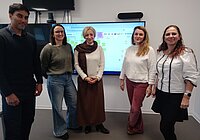
The four-day workshop brought together researchers from South Africa, India, Romania and Germany to develop a joint, power-critical teaching concept for ‘Critical Global Citizenship Education’ (CGCE) in inclusion-oriented teacher training.
The aim was to design an internationally compatible course concept that enables teacher training students to critically reflect on inclusion and diversity in the context of global social injustice and to understand the role of teachers as ‘transformative intellectuals’ (Giroux).
Prof. Dr. Zayd Waghid from CPUT Cape Town (South Africa) and Dr. Mirona Stanescu from BBU Cluj (Romania) were guests throughout the workshop. Anastasia Gordon and Genevieve Lentz (both CPUT), Dr Katharina Schneider-Bertan (University of Cologne; online) and Dr Manish Jain (Dr Ambedkar University Delhi; online) also took part in individual workshop days. Paula Fromm, Dr. Katharina Witte, Prof. Dr. Anselm Böhmer, Prof. Dr. Stefan Jeuk and Prof. Dr. Christoph Knoblauch from Ludwigsburg University of Education were also involved. The workshop was initiated by the International Office of LUE (Charlotte Keefer) and coordinated by Jun.Prof. Dr. Susanne Leitner.
Based on presentations by the participating colleagues (on topics including critical global citizenship, decolonial perspectives, community engagement and inclusion), a framework model was developed to serve as a basis for further work.
In addition to the theoretical foundation, the workshop focused on testing concrete, particularly creative and artistic teaching and learning methods that will later be used in the joint course.
At the same time, organisational and structural issues for joint, internationally networked teaching were addressed.
The main outcome was the development of a draft for a joint COIL (Collaborative Online International Learning) course on critical global citizenship education for Master's students.
This is intended to serve as a starting point for further cooperation and, if necessary, the permanent establishment of CGCE in the curriculum of Ludwigsburg University of Education. It is scheduled to take place between April and June 2026. It is designed to fit into the different teaching frameworks at the participating universities. The core of the course consists of five synchronous online sessions and four phases of international group work, in which students from all participating countries work together in mixed groups. In these groups, students identify real problems of social injustice in their respective contexts, link these to critical theories, reflect on their own positionality and develop symbolic ideas for transformation.
To consolidate the collaboration, further digital meetings will take place, which should contribute to establishing and consolidating a sustainable community of practice for power-critical and internationalised teaching on CGCE.
Interested parties are welcome to join.
Contact: susanne.leitner@ph-ludwigsburg.de
Working together internationally: Networking the Lehramt.International projects in Baden-Württemberg
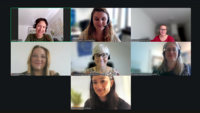
Within the framework of the DAAD's Lehramt.International funding line, networking is required both internationally and nationally. Numerous universities are therefore focusing on diverse and innovative networking formats. This is also the case in Baden-Württemberg. In order to initiate and sustainably strengthen this networking, the projects of the universities of education in Freiburg, Ludwigsburg and Weingarten have initiated a state-wide networking process aimed at intensifying exchange between project coordinators, project managers and, where applicable, international partners.
The aim is to promote operational and strategic cooperation across institutional boundaries and to jointly develop new approaches to future-oriented teacher training. The networking is intended to facilitate collegial consultation, the transfer of good practices, the joint development of various teaching and learning formats and visions, as well as strategic coordination and structural anchoring with a view to internationalisation in teacher training. It is hoped that the projects and the universities will benefit from the diversity of perspectives and the pooled expertise in the state.
In order to concretise these goals and initiate exchange, an initial online networking kick-off meeting with the project coordinators of the model projects took place on 18 September 2025. The kick-off event provided an opportunity for participants to get to know each other. In an open exchange, the projects were presented, initial challenges discussed and good practices shared. It became clear what potential lies in cooperation at the operational and strategic level, how valuable nationwide networking is, and that it is a central concern of the participants to continue the political dialogue already initiated by the DAAD in order to further strengthen internationalisation in teacher training.
The event thus laid an important foundation for future cooperation: it demonstrated not only the great interest in continuous exchange, but also the added value of pooled expertise across university boundaries.
The Lehramt.International funding line offers not only financial support, but also a framework for the cooperative further development of internationalisation strategies – with the aim of preparing future teachers as best as possible for the demands of a globalised educational world.

Following the successful launch of our Brown Bag Series with Prof. Awe on "Teaching Experiences in Nigeria", the second session focused on the topic of international short-term mobility.
Under the title “International Cooperation – Short-Term Stays with Long-Term Impact,” Selina Sauer from the International Office began by outlining the diverse opportunities and framework conditions of a Blended Intensive Programme (BIP).
She was followed by Prof. Dr. Armin Lude and Prof. Dr. Stefan Jeuk, who shared their own hands-on experiences with international short-term formats.
Prof. Dr. Lude reported on a successful BIP conducted in the Netherlands together with students from Ludwigsburg University of Education, while Prof. Dr. Jeuk reflected on the opportunities and challenges he encountered during several short-term teaching stays in Romania in recent years.
The session combined theoretical background with concrete examples and practical implementation ideas – always with a clear focus on the potential of this hybrid mobility format, which blends virtual collaboration with physical presence.
For both lecturers and students, BIPs offer a low-threshold gateway to interdisciplinary and international teaching with long-lasting benefits.
In a relaxed atmosphere with pizza and open discussion, the session also revealed several promising starting points for future international cooperation.
Once again, the active participation confirmed: the Brown Bag format provides a valuable space for fresh impulses and lively dialogue on internationalization and teaching.
We look forward to the next session!
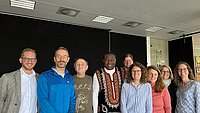
On May 26th, 2025, we proudly hosted our first BBS as part of the INVITE 2.0 project. We were honored to welcome Prof. Dr. Olawale Awe from Nigeria, an esteemed Alexander von Humboldt Scholar, currently conducting research at Ludwigsburg University of Education, who shared valuable insights into his academic journey and research focus.
Prof. Awe is Vice President of the LISA 2020 Global Network (USA) and a leading advocate for integrating statistical consulting into statistics education in Nigeria. He applies the internationally recognized LISA 2020 approach (Laboratory for Interdisciplinary Statistical Analysis), which promotes interdisciplinary collaboration and capacity building through statistical expertise.
With a publication record of over 100 interdisciplinary, peer-reviewed articles, Prof. Awe has made significant contributions to global research through cross-disciplinary cooperation.
We are grateful for his inspiring presentation and look forward to many more enriching sessions to come.
Ludwigsburg
Reuteallee 46
D-71634 Ludwigsburg
Postfach 220
71602 Ludwigsburg