
Digital Innovation and AI
Artificial Intelligence

PHLumi has been in use since last autumn and supports students right from their first point of contact with international opportunities. The chatbot helps both outgoing and incoming students to quickly find the most important information and, where necessary, be directed to the right point of contact.
For outgoing students, PHLumi makes it easier to get their bearings regarding their stay, destination region and duration. Incoming students can also use the chatbot to clarify initial queries and easily find out about the key procedures and points of contact. PHLumi can respond in both English and German, but understands many more languages.
In this way, PHLumi takes some of the pressure off the face-to-face advisory service at the International Office and makes access to information easier and faster.
You can find PHLumi on both the Incoming and Outgoing pages.
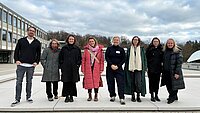
As part of INVITE 2.0, the international workshop ‘Teaching with AI tools: The Role of AI in Transforming Teacher Education’ took place on 26 and 27 November 2025 at the Ludwigsburg University of Education. Participants included lecturers from various disciplines at the Ludwigsburg University of Education, as well as representatives from partner universities in Norway (OsloMet), Denmark (University College Copenhagen), Romania (Babeș-Bolyai University) and Estonia (University of Tartu).
A key focus of the event was the keynote address by Helen Hint (University of Tartu). She reported on a university-wide working group that supports lecturers in the use of AI in teaching and learning, as well as on Estonia’s national AI LEAP initiative, under which teachers are to be systematically trained in AI and AI-based learning tools are to be made available to all upper secondary school pupils. Hint emphasised that these programmes have so far tended to be general in nature and rarely subject- or discipline-specific. She took a critical look at the current debates’ fixation on the question of whether students use AI and whether detection software can identify this – even though such tools are unreliable and distract from what really matters: trust, teaching methodology and meaningful learning objectives. She also pointed out that the discussion is heavily dominated by large language models, meaning that other AI applications which would also be relevant to education are being overlooked. Against this backdrop, she called for greater involvement of teachers, a clearer understanding of their needs, and more empirical research – ranging from student perspectives to tried-and-tested AI literacy materials – in order to make ‘wise’ and forward-looking decisions on the use of AI in education.
These ideas were followed by practical contributions from the fields of English language teaching, art education, educational sciences, computer science and media education – covering topics such as lesson planning with AI in multilingual settings, creative work with text-to-image generators, and the reflective use of AI in everyday school life.
There were also a number of enriching contributions that incorporated the perspectives of teachers, higher education institutions, researchers and students. Participants exchanged views on topics ranging from the text-to-image function in the art department (OsloMet) and the creation of 3D animations in the natural sciences (Cluj-Napoca) to the AI Lit project at the Ludwigsburg University of Education, which focuses on promoting language skills in pre-school children through AI. In addition, a student from Ludwigsburg University of Education shared her experiences of using AI in the classroom with the participants.
On the second day of the workshop, the focus was on developing joint research and cooperation projects. The joint project work met with great interest from all partner universities; in particular, the idea of continuing the concepts developed within a larger consortium was very well received. At the heart of these discussions is a potential EU project that will investigate how teachers in teacher training use AI in their teaching and how they envisage AI changing their professional role in the future.
We can therefore look back on an all-round successful workshop, which not only provided a wide range of insights into teaching and learning with AI, but also laid the foundations for long-term European cooperation in research and teacher training.
Ludwigsburg
Reuteallee 46
D-71634 Ludwigsburg
Postfach 220
71602 Ludwigsburg